European home Parliaments
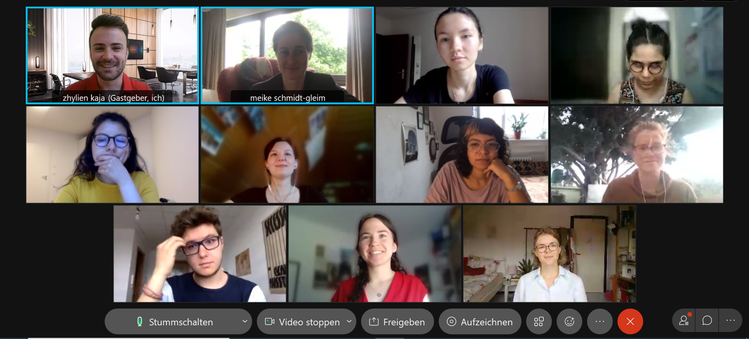
European HomeParliament "European Democracy in Transition" in the framework of the European Weeks, 2023
Under the direction of Zhylien Kaja the Fulda Centre of Transnational Governance organized a European HomeParliament at Fulda University of Applied Sciences on May 16, 2023.
At this year's European Home Parliament, students from the Social Law Department at Fulda University of Applied Sciences, had lively discussions about the importance of citizen participation in strengthening democracy in the European Union (EU). They all agreed that low turnout in European elections is a concern for both the EU and citizens. Citizens have the right to complain about issues they care about, but it is important that they also exercise their right to vote in order to bring about the change they desire.
Sub-questions that were also discussed with students included:
- Should a European referendum be introduced in which all EU citizens can participate and thus have their say on issues concerning the future of Europe?
- Should EU citizens also be able to vote for candidates from other EU Member States in European elections via transnational lists?
- Should EU citizens decide at the local level how many refugees they want to accept in their region and thus facilitate a Europe-wide distribution?
A Home Parliament is a private discussion group of 4 to 8 people with the slogan ‘‘Have a say in the big issues!‘‘. It is moderated by a host, who can either invite his/her friends or have him/herself assigned to an interesting discussion group. It all takes place either online via Video-HomeParliament, WebEx, Zoom etc. or in a face-to-face meeting. European HomeParliaments are an initiative of the NGO “Pulse of Europe”, an independent citizens’ initiative founded in Frankfurt am Main in 2016. “Pulse of Europe” aims at making the idea of European Citizenship visible and audible, and at strengthening the links between EU-politicians and ordinary citizens.

European Home Parliaments - 7th Edition
The European Home Parliaments give citizens the opportunity to engage in discussions about current European topics in an interactive way. For our students this is a great chance to apply the knowledge they have gained about the European Union and thus we participated again in the 7th round of the European Home Parliament.
What are the Home Parliaments?
European Home Parliaments are an initiative of the NGO “Pulse of Europe”, an independent citizens’ initiative founded in Frankfurt am Main in 2016).
The aim of the home parliaments is to bring European debates to citizens’ homes and discuss current European topics in small groups. This can work among family members, friends or in our case students. Usually, three questions of European matter are discussed and then voted upon (just like in a real parliament).
This year’s topics:
The overall question of this years’ round was: Europe on the next level: Do we need a deeper cultural and political integration?
This included three further proposals and questions:
- European Public Holiday: Should there be a joint European Public Holiday to commemorate Europe’s shared history and values?
- History in Europe’s Classrooms: Should history education in Europe’s schools provide more common European content and go beyond national narratives?
- EU Membership Process: Should EU enlargement be accelerated for countries with candidate status?
The discussion
Students were divided into three groups and discussed one question each. They engaged in lively discussions and then presented their results to the other students. After that, we voted on each question and finally on the overall question. Students were very engaged in the debate and enjoyed the interactive nature of the home parliaments. It was interesting to see, how the opinions varied from being very critical to agreeing very much with the question.
We thank everybody for participating in the debate and are curious to see how these debates continue on the European level.


European Home Parliaments May 2022
For the second time, students of Fulda University of Applied Sciences participated in the European HomeParliaments - this time live on campus. Maria Keller and Zhylien Kaja organized the event and five students acted as moderators for the discussion groups.
European HomeParliaments are an initiative of the NGO “Pulse of Europe”, an independent citizens’ initiative founded in Frankfurt am Main in 2016. “Pulse of Europe” aims at making the idea of European Citizenship visible and audible, and at strengthening the links between EU-politicians and ordinary citizens. A Home Parliament is a private discussion group of 4 to 8 people with the slogan ‘‘Have a say in the big issues!‘‘. It is moderated by a host, who can either invite their friends or have themselves assigned to an interesting discussion group. It all takes place either online via Video-HomeParliament, WebEx, Zoom etc. or in a face-to-face meeting.
This years' questions included
- Should the principle of unanimity in the council of the European Union be abolished and replaced by a qualified majority? (Soll das Einstimmigkeitsprinzip im Rat der Europäischen Union abgeschafft und durch eine qualifizierte Mehrheit ersetzt werden?)
- Should a representative citizens' council advise the EU institutions on fundamental decisions? (Soll ein repräsentativer Bürgerrat der EU Institutionen bei grundlegenden Entscheidungen beratend zur Seite stehen?)
- Should the European Parliament be able to introduce its own legislative proposals in addition to the EU Commission? (Soll neben der EU-Kommission auch das Europäische Parlament eigene Gesetzesvorschläge einbringen können)
The students - who got divided into three groups - had some lively discussions about the questions. Most of them agreed on questions 1 and 2 but disagreed on the third question. We are now keen to see what the overall results of the HomeParliaments will show and especially what the EU politicians will make of the results.


European Home Parliament 2021
Under the direction of Prof. Dr Claudia Wiesner and Zhylien Kaja the Centre of Transnational Governance organized a European HomeParliament at Fulda University of Applied Sciences on June 22, 2021.
European HomeParliaments are an initiative of the NGO “Pulse of Europe”, an independent citizens’ initiative founded in Frankfurt am Main in 2016. “Pulse of Europe” aims at making the idea of European Citizenship visible and audible, and at strengthening the links between EU-politicians and ordinary citizens.
A Home Parliament is a private discussion group of 4 to 8 people with the slogan ‘‘Have a say in the big issues!‘‘. It is moderated by a host, who can either invite his/her friends or have him/herself assigned to an interesting discussion group. It all takes place either online via Video-HomeParliament, WebEx, Zoom etc. or in a face-to-face meeting.
The European HomeParliament at Fulda University of Applied Sciences offered students the opportunity to discuss the following question: ‘‘Soll die EU in zukünftigen pandemischen Krisen entschiedener europäische Interessen vertreten? / Should the EU represent European interests more decisively in future pandemic crises?‘‘ in a setting that incorporates parliamentary time frames and rules.
They were divided into three discussion groups of 4 to 8 students and had about 2 hours to discuss three proposals on an issue of EU politics such as: the vaccine production in the future, the question of vaccine export, and unrestricted travel within the European Union after vaccination.
The results of the discussions are uploaded to the European Home Parliament’s platform (you can find it here), where the results of all European house parliaments are collected. The results reach top EU politicians such as Ursula von der Leyen (the President of the European Commission); Othmar Karas (EVP); Manfred Weber (EVP); Pedro Marques (S&D); Helmut Scholz (GUE/NGL); Gabriele Bischoff (S&D) etc., who are looking forward to exchanging ideas with citizens, students etc. These politicians have agreed to take the findings into account in their deliberations and then give feedback in webinars, video statements or in writing as Ursula von der Leyen did.